 ← All insights
The specific problem of a beauty hall
In an energy or industrial hall, a well-made stand stands out simply by being well-made. At Beautyworld it does not. The baseline is already high: competitors invest in finish, lighting and product display as a matter of course, because their product category is itself visual.
That changes what the design has to do. The task is not to look good — everything looks good. It is to be *distinguishable* at a distance, and then to reward the visitor who walks in.
Scale is not the lever
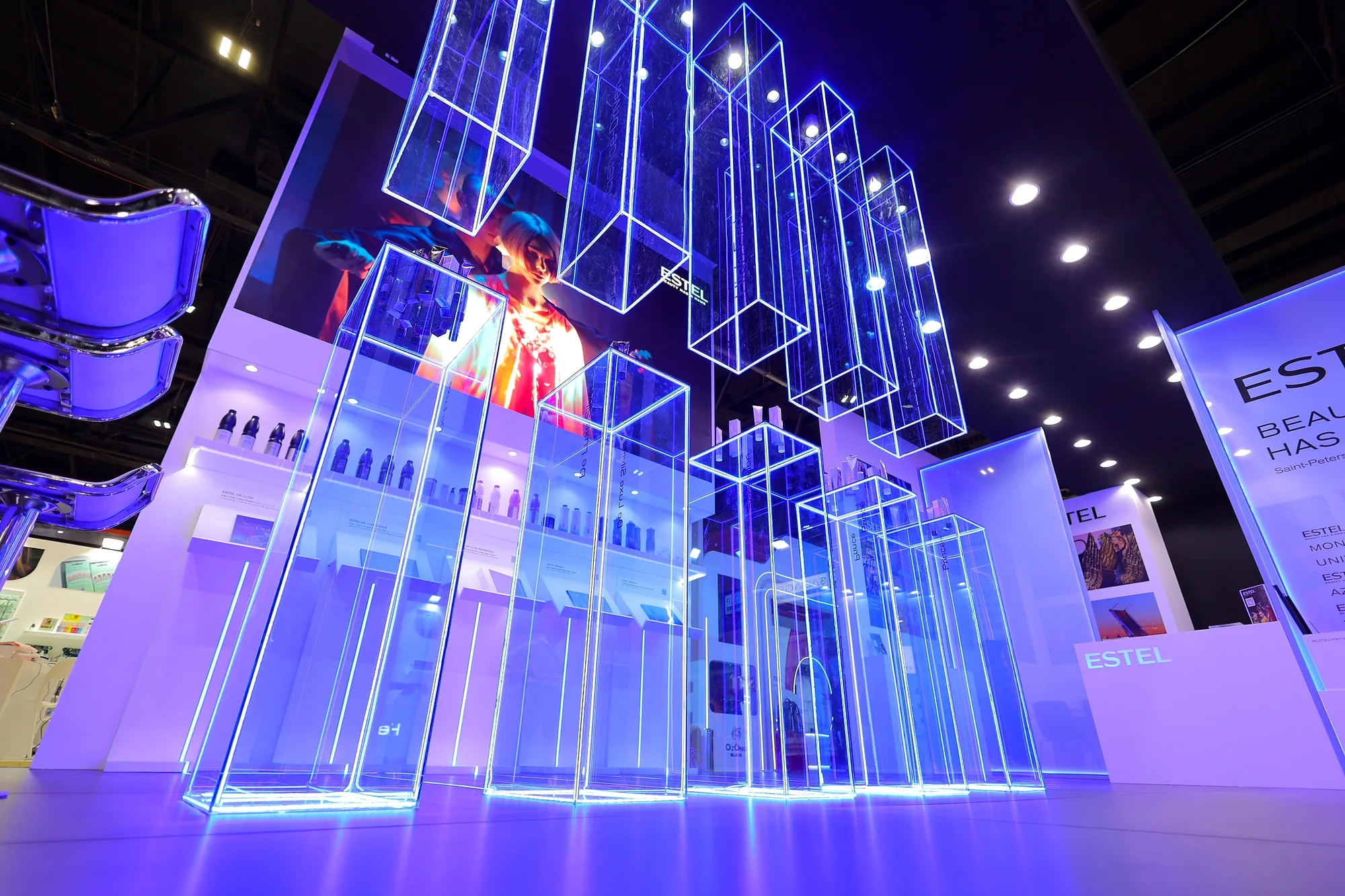
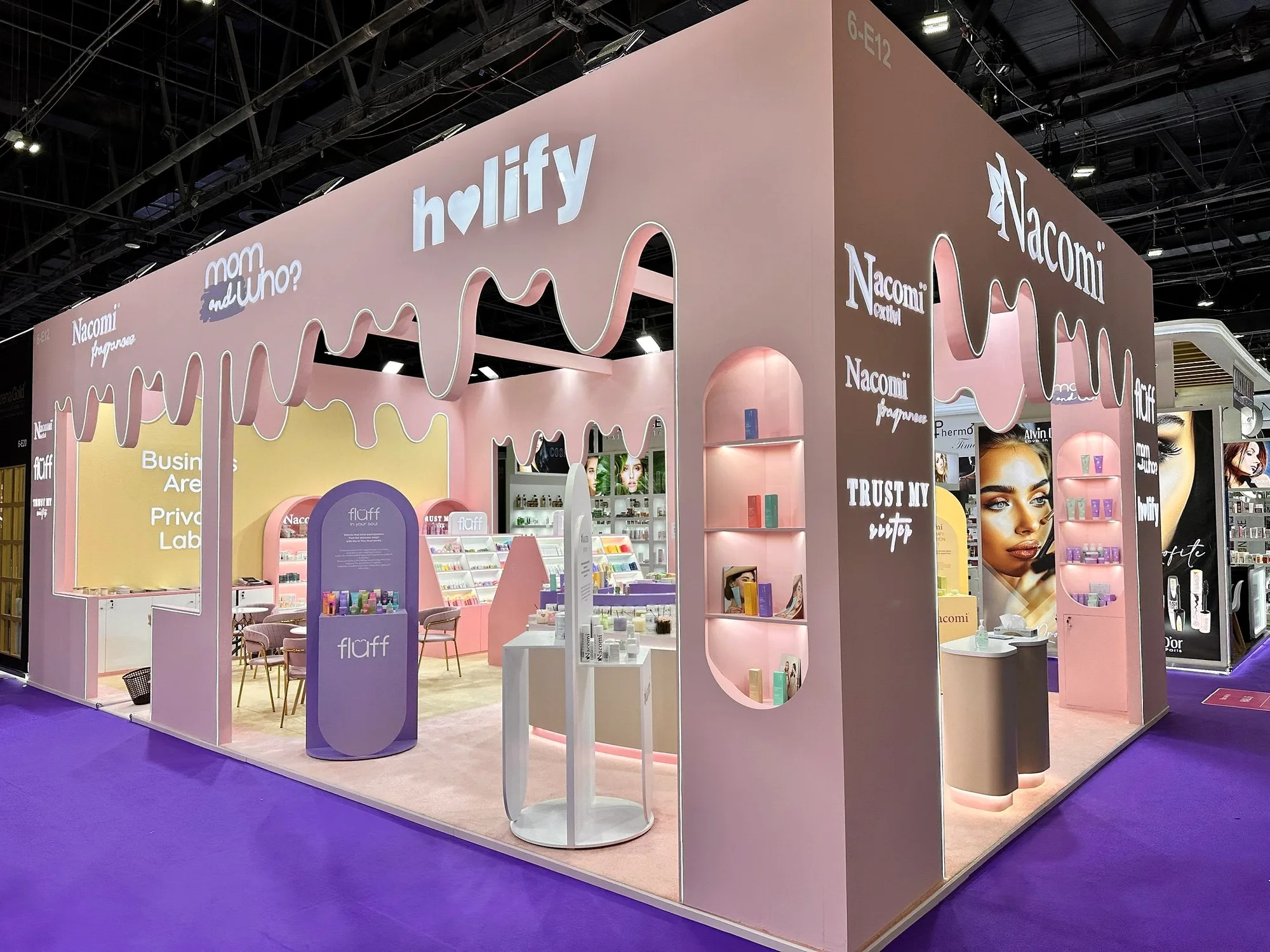
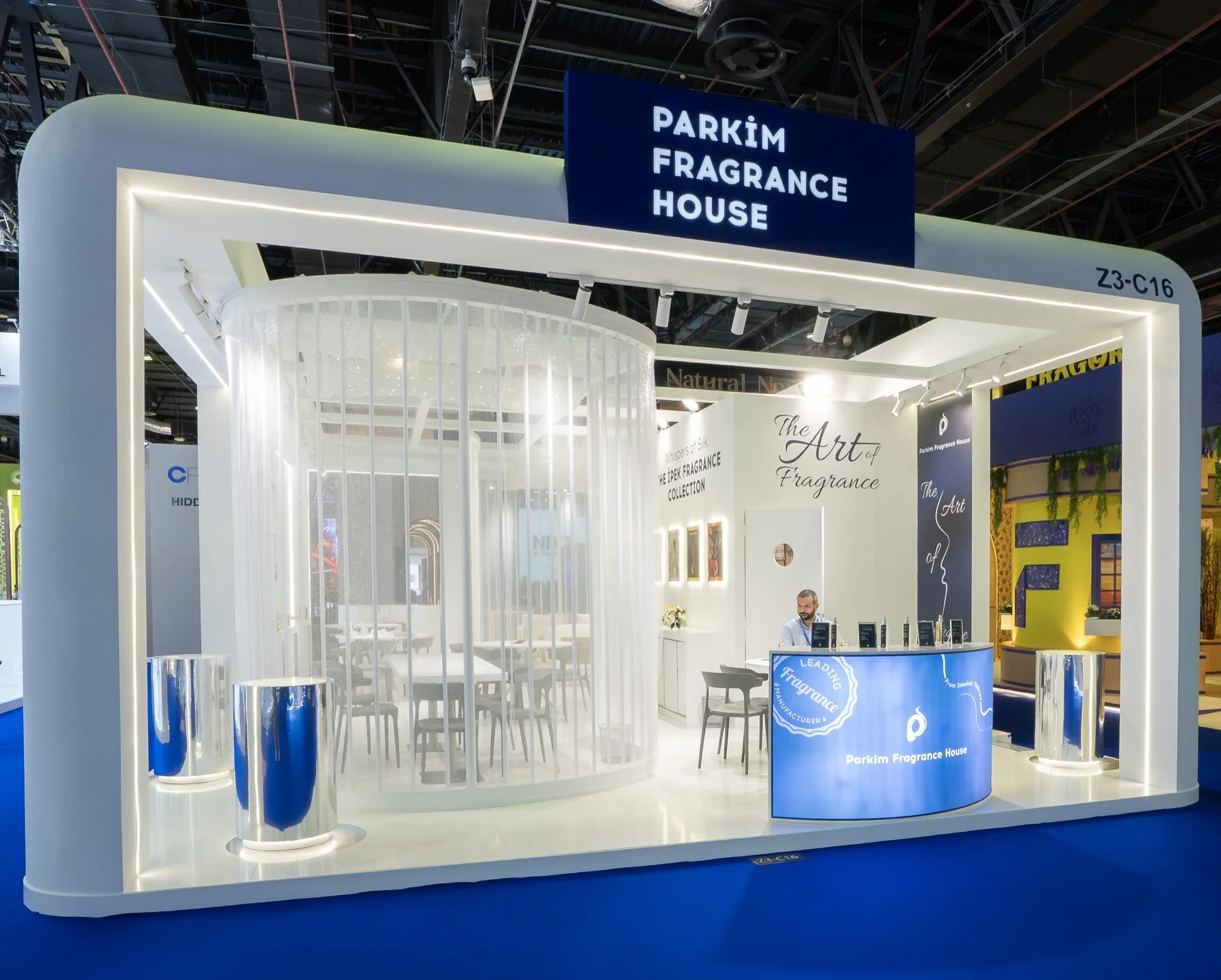
The Beauty Sky Beautyworld records cluster in the 90–150 m² range: Nacomi at 90 m², Parkim at 100 m², ESTEL at 102 m², Fragrance Science at 150 m². These are not large stands, and they sit in the same halls as considerably bigger ones.
What they share is a single decision made early: one idea that reads from the aisle, and everything else subordinated to it. A stand that expresses four ideas at 150 m² reads as noise; a stand that expresses one at 90 m² reads as intent.
Three devices that reliably work
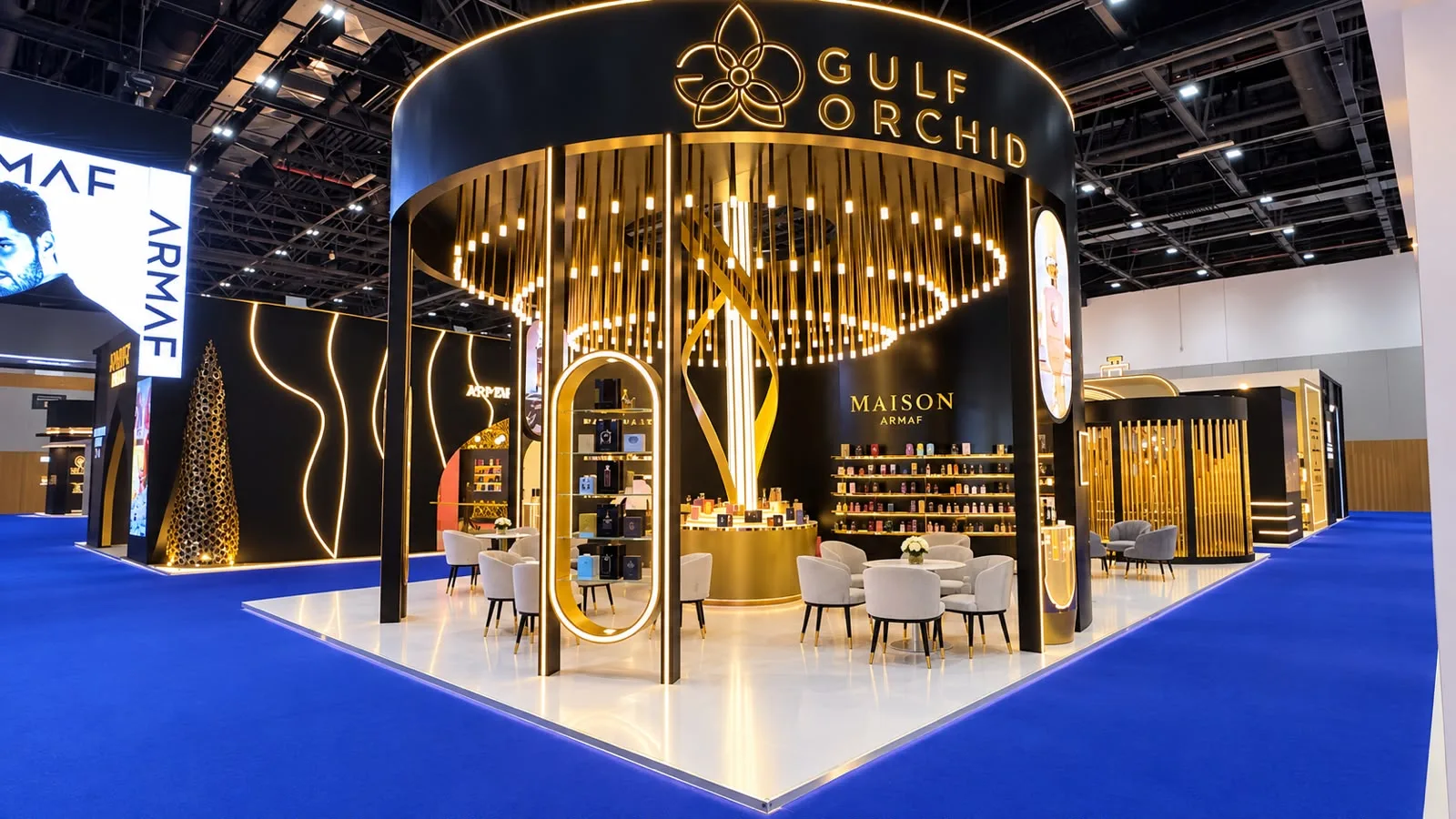
The first is a threshold you have to notice. Nacomi used a drip-edge portal in a soft pink architectural frame — a silhouette unlike anything adjacent. Gulf Orchid used a sculptural gold portal against a black architectural mass, which in a hall of white and pastel is an inversion rather than an escalation.
The second is light used as structure rather than garnish. ESTEL built a field of illuminated transparent volumes with linear light, creating a memorable silhouette from several approaches across the hall. Parkim used a luminous rounded frame and a sheer curtain room so the stand read as translucent rather than solid. In both, light defines the architecture instead of decorating it.
The third is a single landmark object. Fragrance Science centred its ‘5 Continents Collection’ globe; Iberchem used backlit geometric screens and a faceted reception counter. One object a visitor can point at does more than a perimeter of evenly-lit shelving.
The part most stands get wrong
Beautyworld is a trade show, and the conversations that justify the investment are slow: distribution, private label, formulation, exclusivity. Those conversations need somewhere to happen that is neither the aisle nor a closed box.
The records that handle this well build a gradient rather than a wall. Nacomi placed a dedicated Business Area for private-label discussion behind the public product zones. Parkim moved from threshold theatre through a curtain room to an intimate scent counter. Chemarome and Zaphir used stepped hospitality to separate two brands inside one compact footprint.
A stand with no semi-private layer forces a choice between being interrupted and being closed. Both cost meetings.
What twelve editions actually show
Beauty Sky's Beautyworld record runs from Moellhausen in 2014 to Gulf Orchid and Parkim in 2025 — twelve retained projects across eight editions, including single brands, fragrance houses, and the Poland and Spain national pavilions.
Read in sequence, the visual language changes completely across that span: Moellhausen's oversized editorial typography and precise white architecture in 2014, Iberchem's backlit geometry in 2020, ESTEL's illuminated volumes in 2023, Gulf Orchid's black-and-gold theatre in 2025. What does not change is the underlying discipline — one idea, legible at distance, with a route inward that ends somewhere you can hold a conversation.
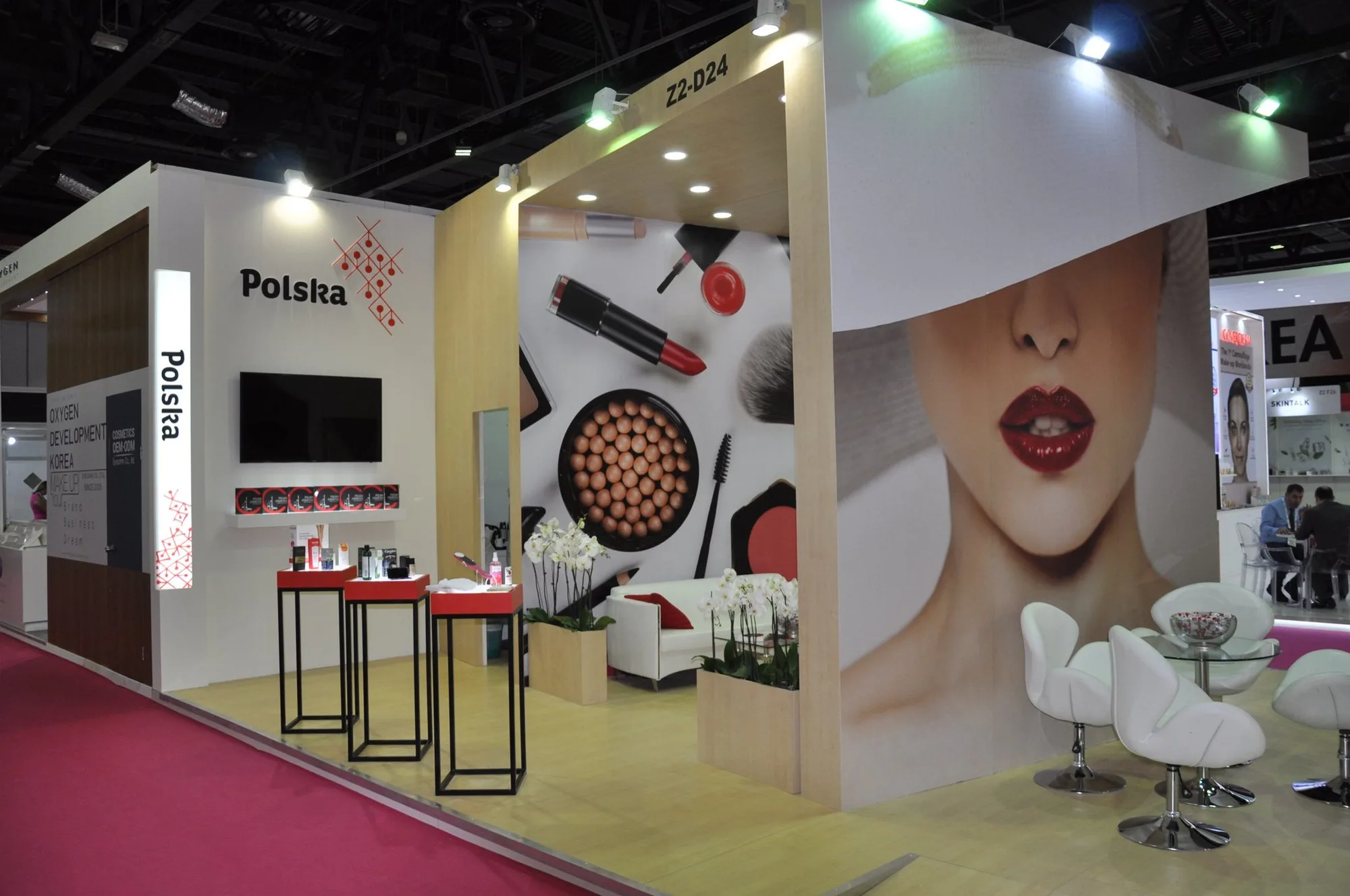
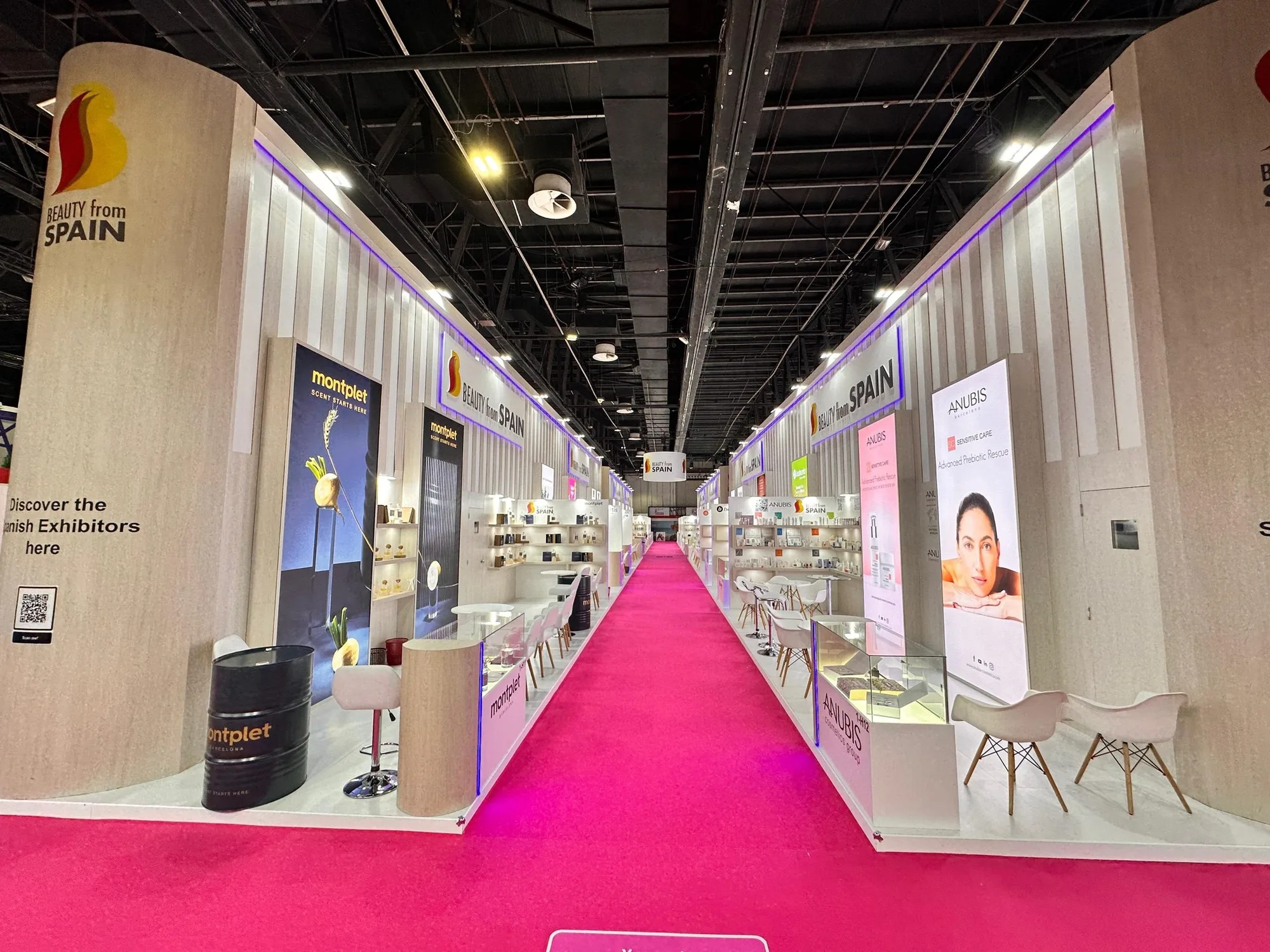
The pavilions apply the same logic at a different scale: Poland organised 480 m² of competing cosmetics brands under shared wayfinding, and the Spain platform reached 1,200 m² in 2021 while keeping individual brand frontages open and commercially usable.