 ← All insights
Start from the meeting schedule, not the elevation
The commercial return at ADIPEC comes from scheduled conversations: existing partners, ministries, operators, contractors. Those meetings are booked before the show and they run back to back for four days.
So the first design question is arithmetic, not aesthetic. How many simultaneous meetings must the stand hold at peak? How many need to be private rather than merely quiet? How many people per meeting, and do any require catering or a screen?
Answer that before the first sketch and the floor plan largely designs itself. Answer it afterwards and you end up converting display area into meeting area at the worst possible moment.
The hospitality gradient
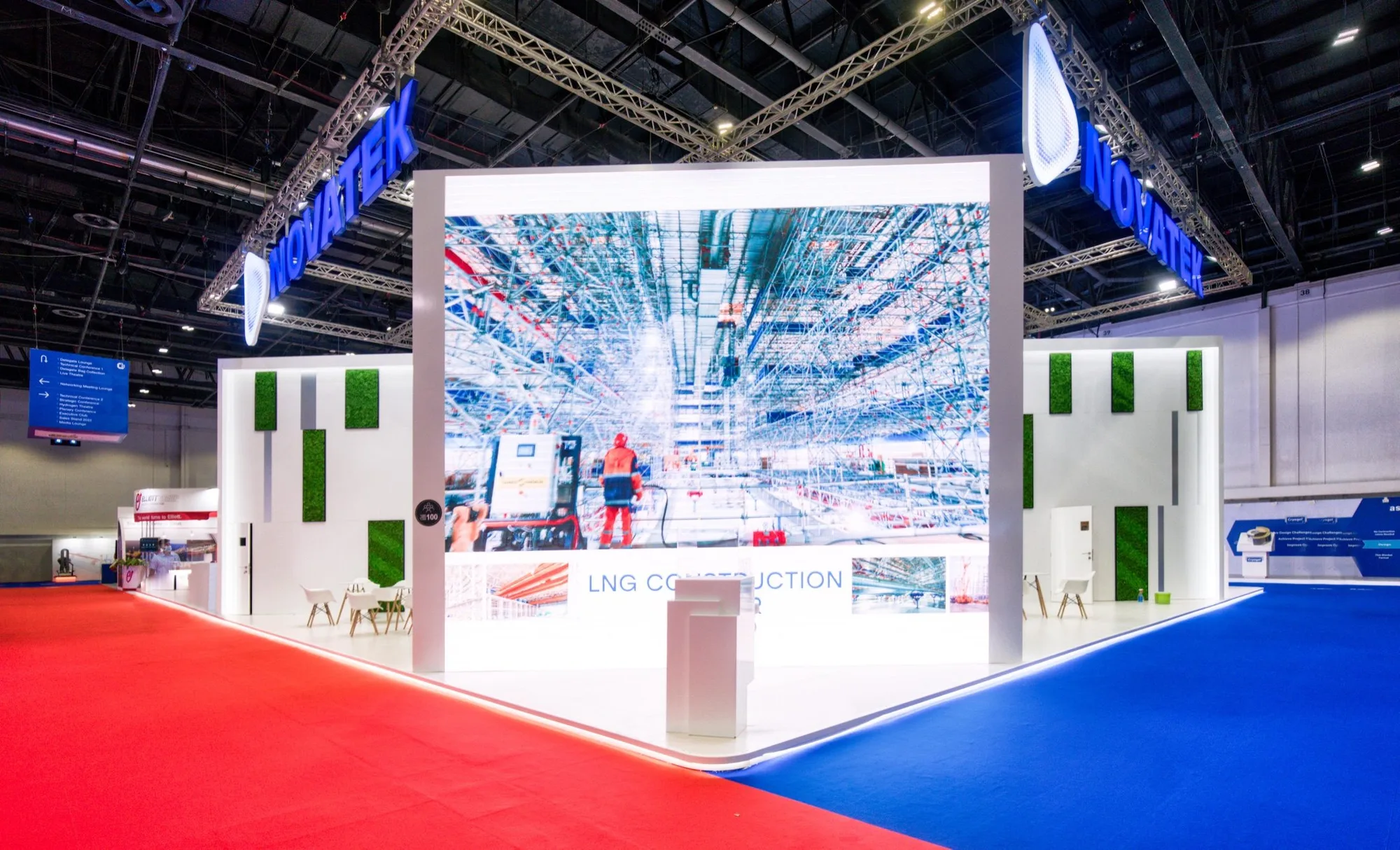
The Novatek stand at Gastech — a 400 m² energy environment built on the same principles — resolved this with a clear sequence: a central digital storytelling volume for public orientation, moss-panel meeting thresholds, then fully fitted boardrooms for private discussion. Public, semi-private, private, in that order, along a route.
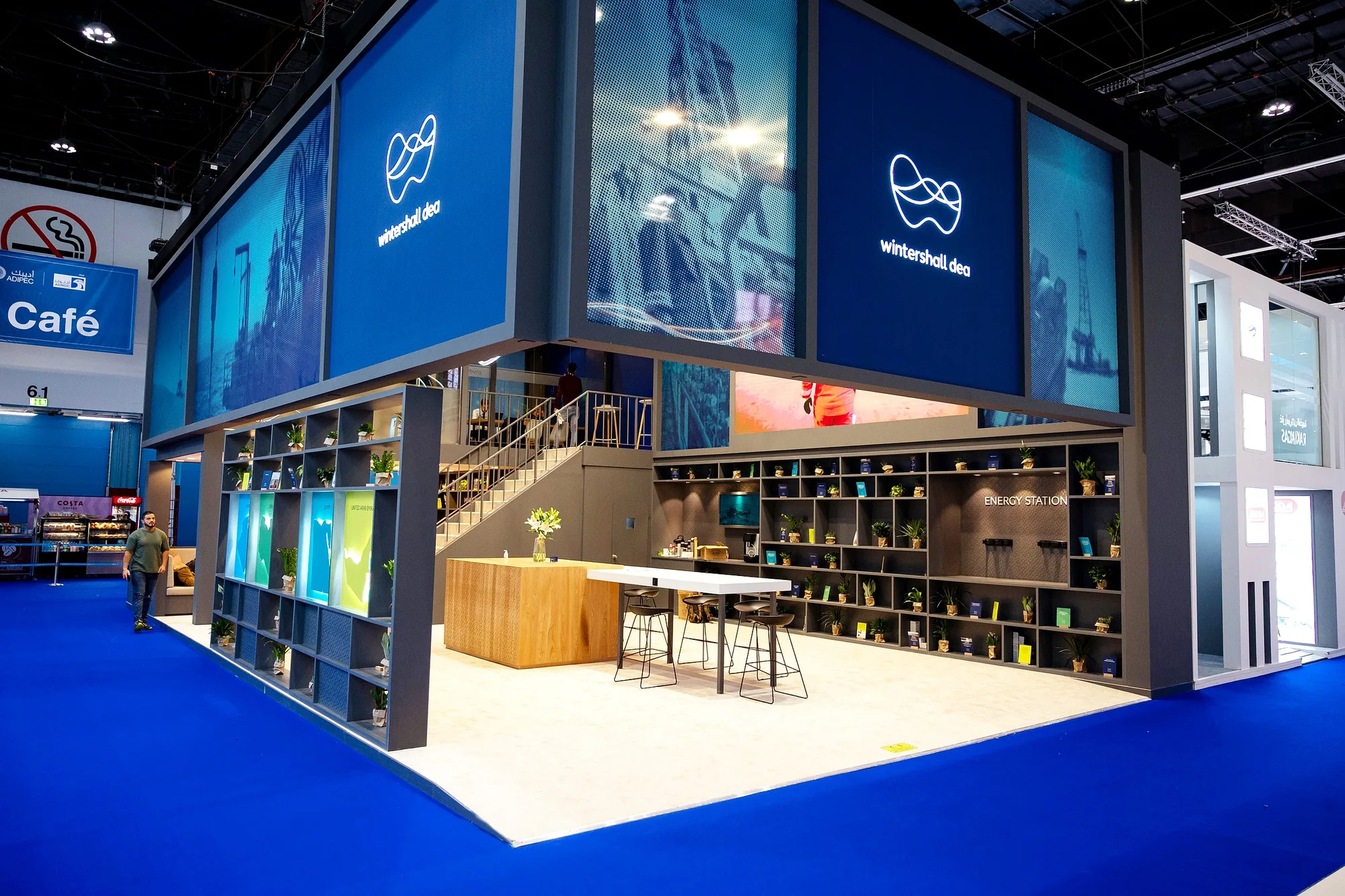
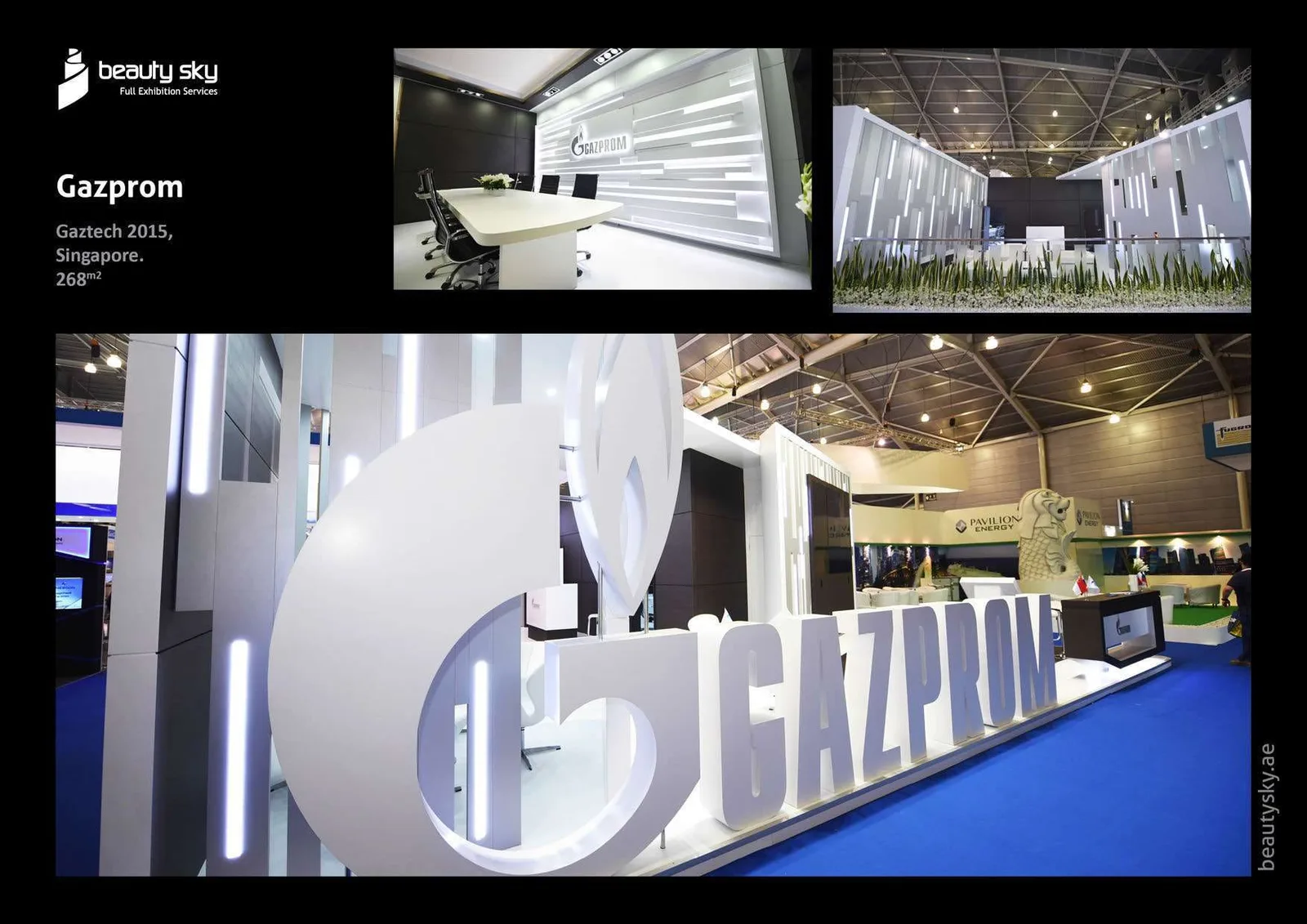
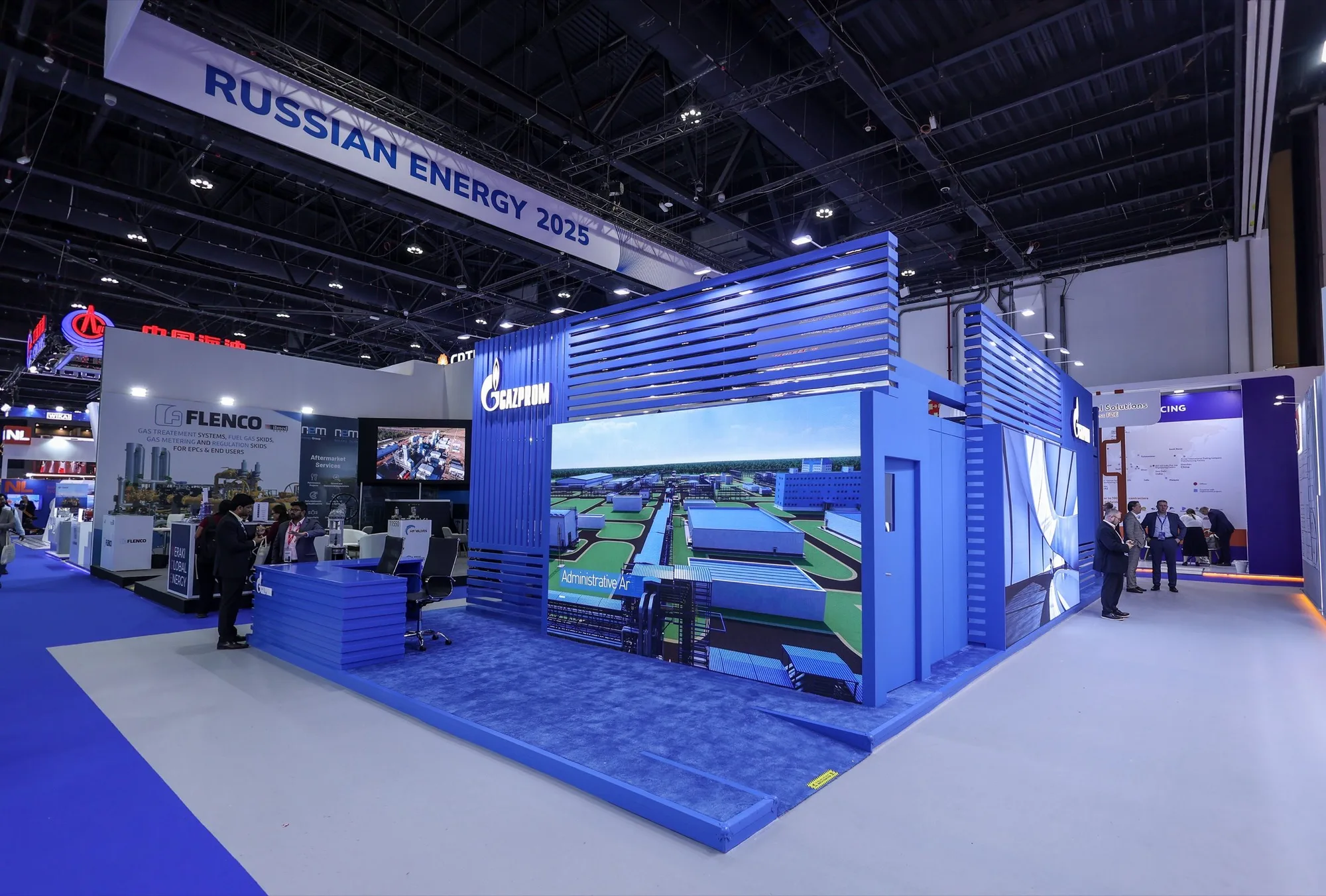
At ADIPEC the same structure recurs. Gazprom paired long-range brand geometry and an integrated media wall with controlled interior space for executive engagement. Wintershall's 200 m² stand in 2022 balanced technical communication with open meeting zones and high visitor flow.
The failure mode is a stand that is either all frontage or all boardroom. The first has nowhere to do business; the second is invisible.
Long-range identity in a hall of large stands
ADNEC halls at ADIPEC are full of well-funded stands. Height and brightness are contested by everyone, so neither is a strategy on its own.
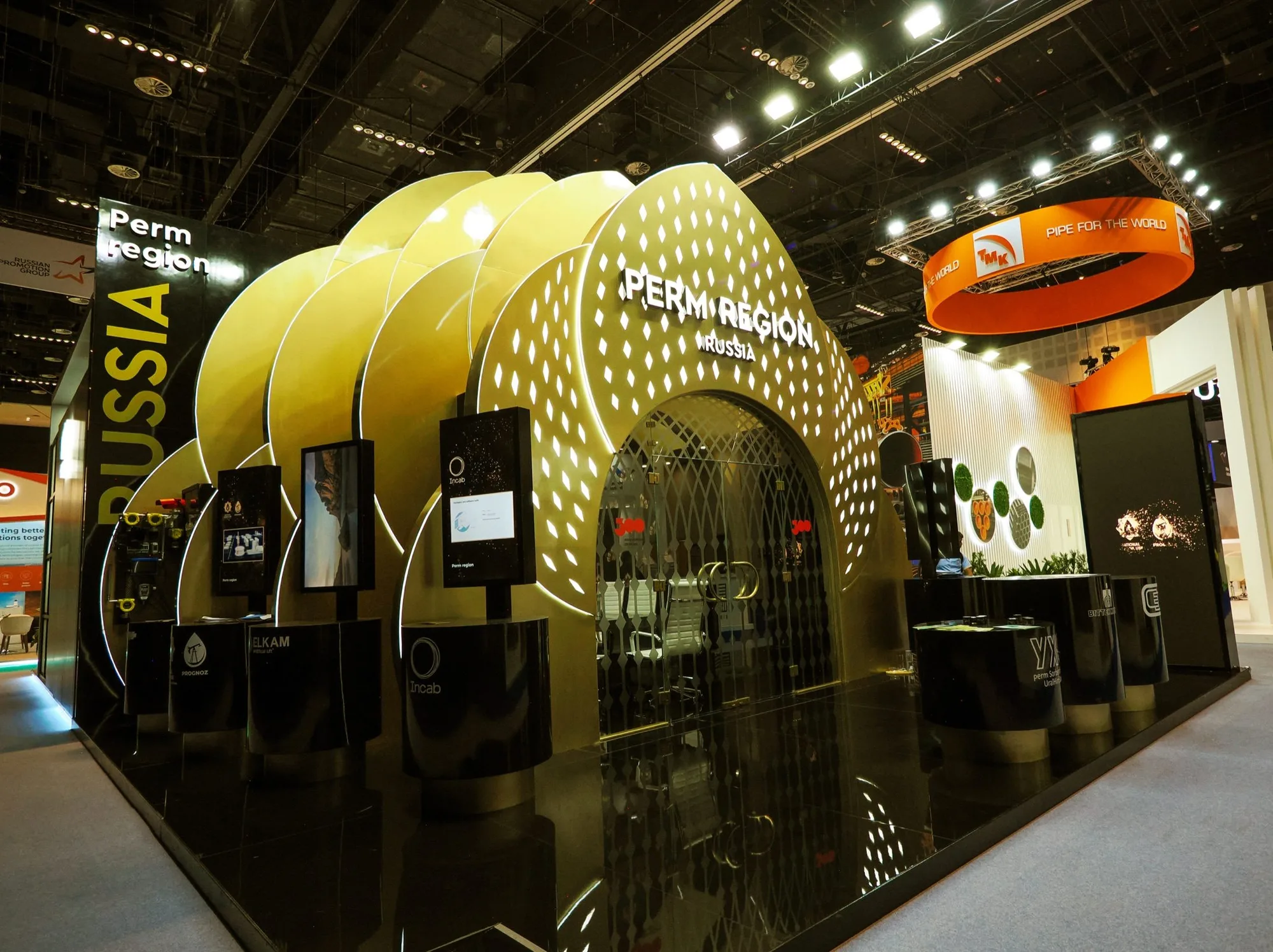
What works is a recognisable silhouette. Gazprom used layered horizontal fins and strong brand geometry to produce a shape identifiable before the logo is legible. Perm's 2023 pavilion used a black-and-gold architectural frame with a scalloped ceiling rhythm — in a sector that defaults to blue and white, a high-contrast palette does more work than additional lumens.
The test is simple: photograph the stand in silhouette. If it could be any exhibitor in the hall, the design has not solved the identity problem yet.
Repeat presence compounds
Perm exhibited at ADIPEC in 2023, 2024 and 2025 — three consecutive editions, at 80 m² in 2024 and 90 m² in 2025. Across that run the black-and-gold language stayed constant while the plan opened up, improving visibility, hospitality and the flow of technical conversation.
That continuity is an asset most exhibitors discard. Returning visitors recognise a stand they have visited before, and the design cost of an evolution is materially lower than a fresh concept each year. Deciding at the outset that a stand is a multi-year platform rather than a single-show build changes the engineering, the material choices and the storage plan.
Settle these before design begins
Peak simultaneous meetings, and how many must be fully private.
Whether delegations or protocol visits are expected — these need a defined arrival point, not an improvised one.
What content genuinely needs a screen. Large-format media is the most over-specified element on energy stands; it earns its place for process, scale and things with no physical object, and rarely for a brand loop.
Whether the structure returns next year, which is an engineering decision rather than a later preference.
Rigging rights, load limits and power draw, confirmed against the ADNEC manual rather than assumed from last year.